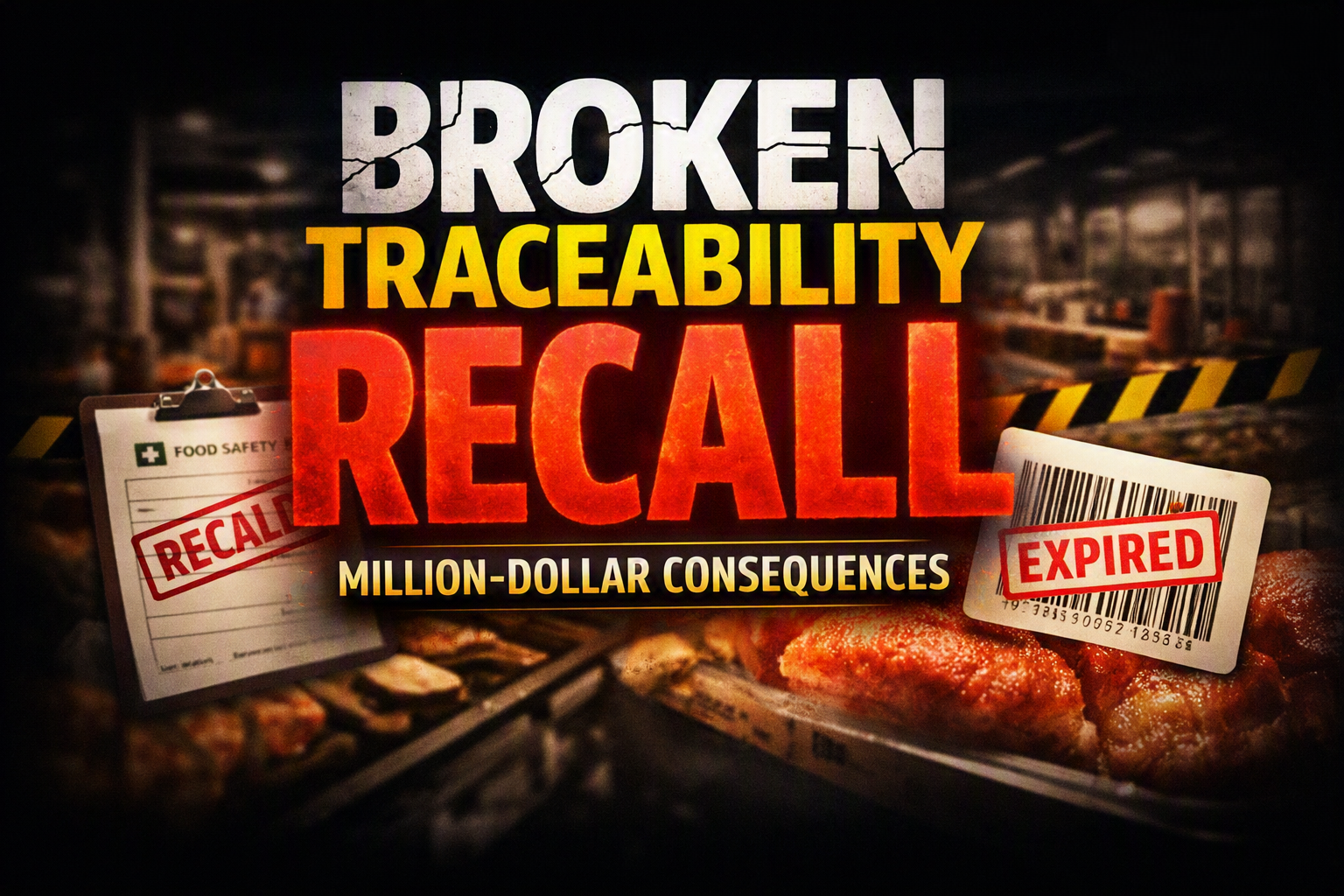
What it costs when you can't back up a claim
Originally published as “The Silent Cost of Broken Traceability: Why Missing Data Can Trigger Million-Dollar Recalls”
August 10, 2026
Food recalls rarely begin with a dramatic failure. More often, they start with something deceptively smalla missing supplier record, an incomplete batch history, or a certificate that cannot be verified. For consumers, a recall announcement may appear overnight, but behind the scenes, companies are scrambling to answer one critical question: “Where did this product come from, and where did it go?”
The stakes are enormous. According to industry estimates, the average direct cost of a food recall exceeds $10 million, not including indirect costs such as litigation, lost sales, and brand damage. In 2025 alone, over 300 recalls were reported globally, with some leading to bankruptcy. High-profile cases like Blue Bell Creameries’ $19 million fine for listeria contamination and the Peanut Corporation of America’s collapse after a salmonella outbreak highlight how broken traceability can destroy entire businesses.
Traceability Beyond Simple Tracking
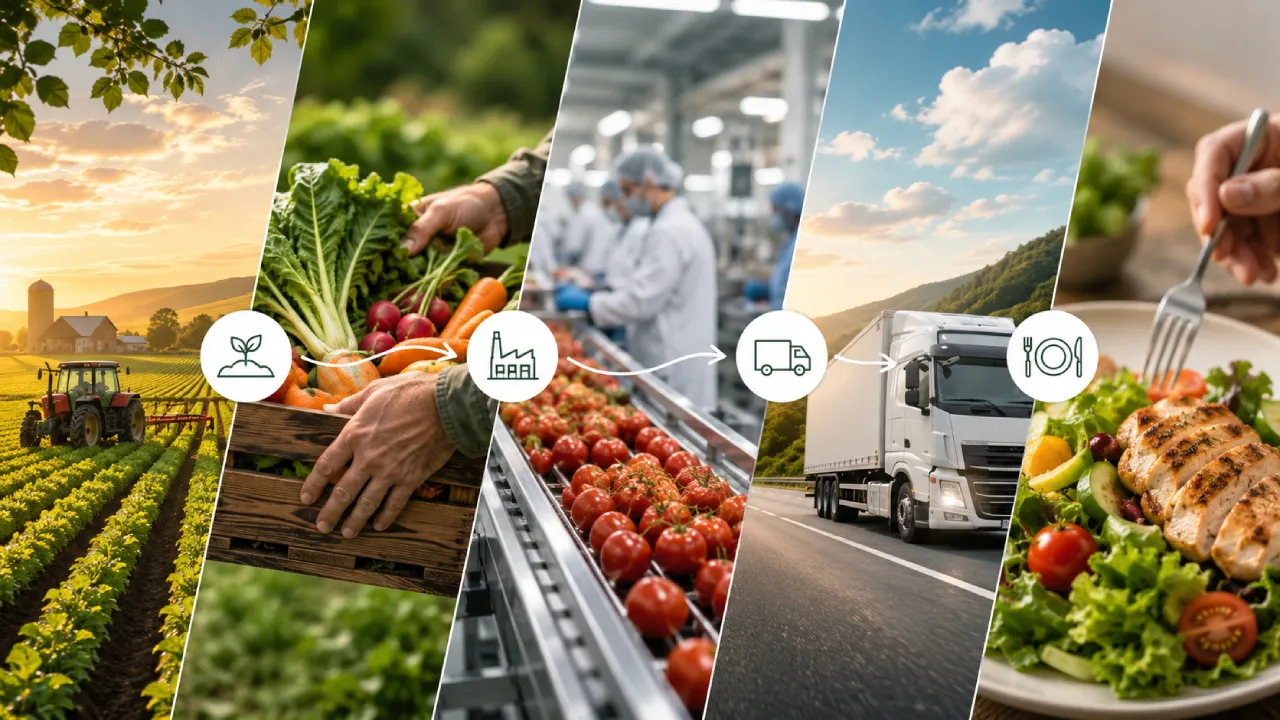
Traceability is often misunderstood as simply knowing where a product was produced. In reality, modern food traceability requires visibility across the entire supply chain from farms and suppliers to processing facilities, packaging operations, distribution networks, and retail channels. Each step must be connected with evidence: ingredient sources, production dates, batch numbers, certifications, testing records, and transportation details. Without this information, businesses lose the ability to make fast, targeted decisions when safety issues arise.
When Recalls Become Search Operations
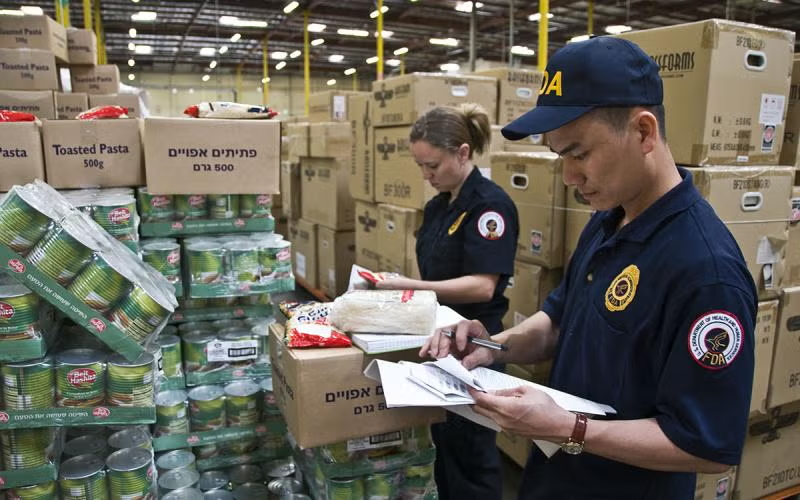
Imagine a manufacturer discovers that a batch of ingredients may be contaminated. Ideally, they should be able to identify the affected supplier, locate impacted production batches, trace their distribution, and remove only unsafe products. Without accurate records, however, companies face uncertainty. Instead of a precise recall, they are forced into a costly search operation, removing large quantities of products simply because they cannot prove which ones are safe. The cost of uncertainty often exceeds the cost of the original issue.
The Financial and Operational Impact
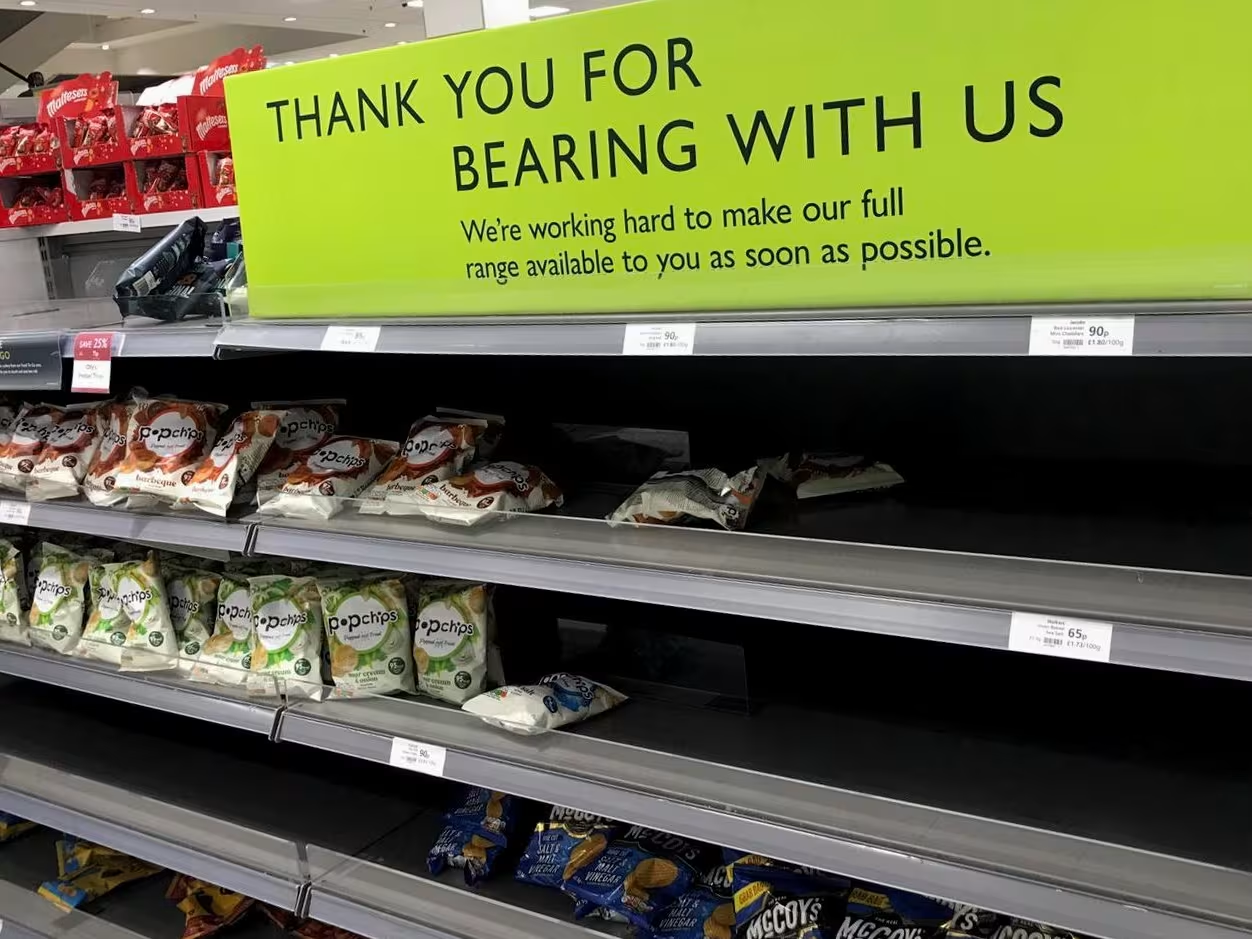
Poor traceability creates ripple effects across the business. Financially, recalls mean destroyed inventory, transportation expenses, warehouse handling, and replacement products. Operationally, recalls disrupt entire organizations, pulling quality assurance, supply chain, legal, customer service, and communications teams into crisis mode. Most damaging of all is brand trust. Consumers may forgive a mistake, but they are far less likely to forgive a company that cannot explain what happened. Retailers and partners also lose confidence, jeopardizing future relationships.
Regulators are also raising the bar. Under the U.S. Food Safety Modernization Act (FSMA) Section 204, companies must provide traceability data within 24 hours of a contamination investigation. Failure to comply can result in fines up to $500,000 per violation, and in severe cases, criminal charges. The European Union’s Farm to Fork Strategy similarly emphasizes transparent supply chains, making traceability not just a compliance requirement but a competitive necessity.
Why Manual Systems Are No Longer Enough
Many food businesses still rely on PDFs, emails, spreadsheets, and manual documentation. While these systems may suffice at a small scale, global supply chains introduce multiple suppliers, certifications, production sites, and international routes. Manual processes lead to duplication, human error, expired certificates, and slow audits. The issue is not a lack of information it is disconnected information that cannot be acted upon quickly.
From Data Collection to Data Intelligence
The future of traceability is not about collecting more documents but about transforming data into intelligence. Modern platforms can connect supplier information, verify certifications, track batches, monitor compliance, and prepare audit evidence seamlessly. Artificial intelligence further enhances this process by extracting insights from unstructured documents such as certificates, laboratory reports, and audit files, turning static records into actionable intelligence.
How TilliT Solves the Traceability Challenge

This is where TilliT provides a transformative solution. Designed for modern food businesses, TilliT connects product origin and supply chain data into one unified system. It enables companies to track every product batch with complete visibility, verify food badges with document backed proof, and manage certifications in a centralized platform. TilliT also generates transparent, SEO friendly trust pages, making products ready for AI-powered discovery while reducing compliance effort and costs by up to ten times. By eliminating disconnected data and replacing manual processes with intelligent automation, TilliT ensures that recalls never become costly search operations.
Final Thoughts
Broken traceability does not always create immediate problems, which is precisely what makes it dangerous. Missing data sits quietly until a recall, audit, or compliance challenge exposes the weakness. For food companies operating in complex global markets, traceability is no longer just about knowing where products traveled it is about having the evidence to prove every claim. Trust is not created by a statement; trust is created by proof. With TilliT, every product can have a story backed by data, turning compliance into confidence and transparency into trust.