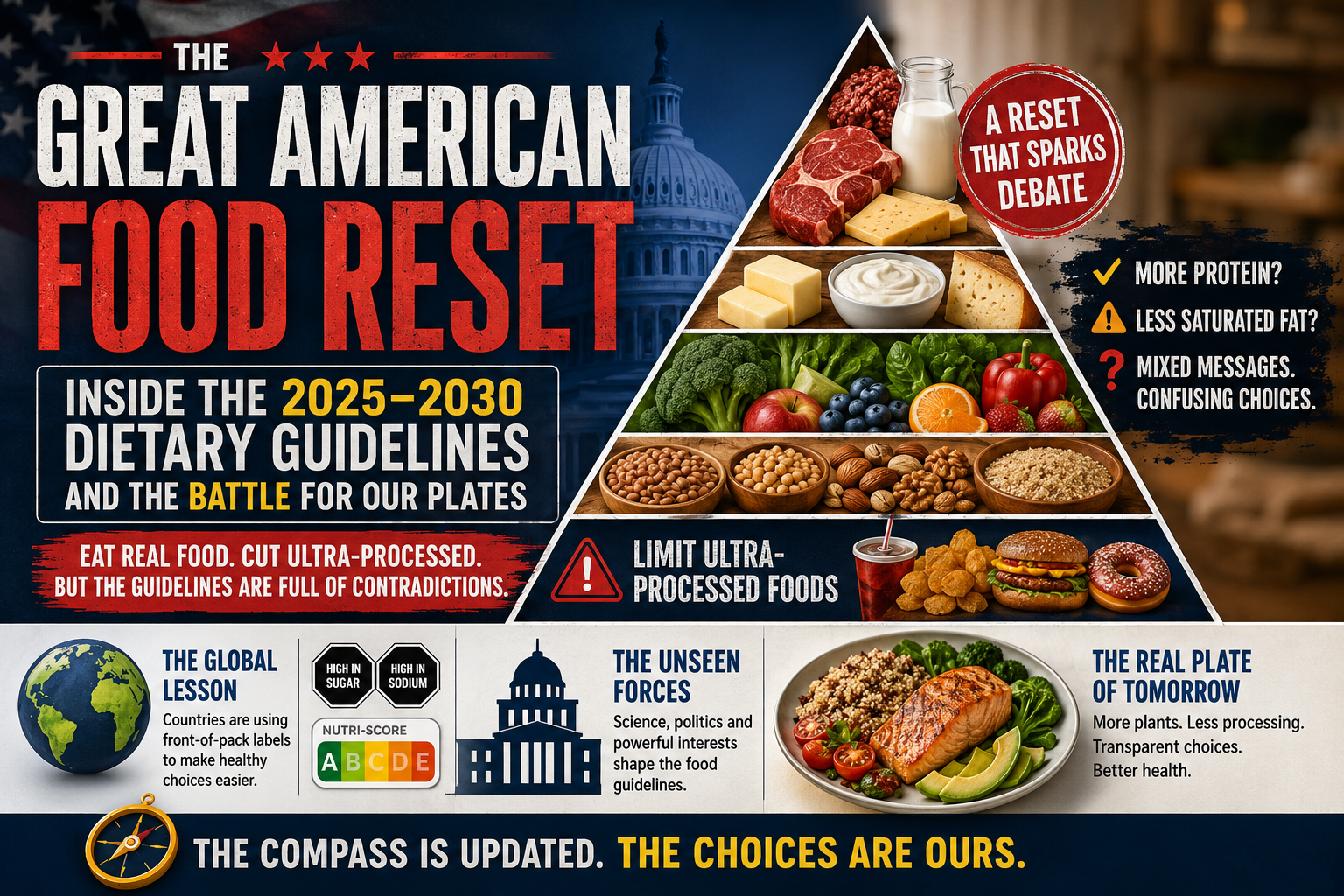
How food labelling is changing in the US
Originally published as “The Great American Food Reset: Inside the 2025-2030 Dietary Guidelines and the Battle for Our Plates”
January 28, 2026
More than 80% of healthcare dollars in the United States are now spent treating chronic illness, a staggering proportion of which is directly driven by what we eat. This isn't a quiet statistic; it's a deafening alarm bell ringing through hospitals, clinics, and family kitchens. Seventy percent of US adults have overweight or obesity, one in three have prediabetes, and nearly half of all cardiometabolic deaths—heart disease, stroke, and diabetes—are now linked to poor diet. For decades, the official Dietary Guidelines for Americans have been the nation's nutritional compass, a document meant to translate science into survival. Yet, as chronic disease rates have climbed, a persistent question has lingered: has that compass been pointing us in the right direction, or has it been subtly steered off course?
In January 2026, the U.S. Department of Health and Human Services and the U.S. Department of Agriculture released the Dietary Guidelines for Americans, 2025–2030, calling it the most significant reset of federal nutrition policy in decades. The administration declared it was restoring 'scientific integrity, accountability, and common sense' with a clear message: eat real food. But within that simple directive lies a complex and contentious battlefield. The new guidelines simultaneously champion high-quality protein and warn against saturated fat, promote whole foods while visually elevating animal M More than 80% of healthcare dollars in the United States are now spent treating chronic illness, a staggering proportion of which is directly driven by what we eat. products, and take a firm stand against ultra-processed foods—a category finally being called by its name. This isn't just an update; it's a reflection of a nation wrestling with its health, its food supply, and the very evidence that should guide it forward.
"More than 80% of healthcare dollars in the United States are now spent treating chronic illness, a staggering proportion of which is directly driven by what we eat."
The Core Tension: A Guideline at War with Itself
The 2025-2030 guidelines arrive with a powerful, unifying battle cry against ultra- processed foods. This explicit focus marks a watershed moment, moving beyond vague advice about 'moderation' to directly name the engineered, additive-laden products that now constitute nearly 60% of the average American's caloric intake. The call to limit these foods is perhaps the document's strongest and most scientifically grounded consensus point, echoed by public health institutions and nutrition experts alike. It's a recognition that the problem isn't just individual nutrients gone rogue, but an entire system of food designed for shelf-life and crave-ability over nourishment.
Yet, within this clear stance, a profound internal contradiction emerges, creating what many experts see as a fundamental flaw. The guidelines firmly advise limiting saturated fat to less than 10% of total daily calories, a longstanding recommendation backed by cardiovascular research. In the very next breath, they actively promote foods notoriously high in that very nutrient: red meat, full-fat dairy, butter, and even beef tallow. For the average person trying to follow this advice, the math simply doesn't work. Consistently choosing the promoted 'real foods' like steak and cheese would almost certainly push saturated fat intake well past the recommended limit. The Academy of Nutrition and Dietetics, while supporting many aspects of the guidelines, pinpointed this as a significant concern. It's as if the guidelines are trying to champion a return to traditional, whole-food eating while ignoring the modern scientific understanding of the downsides of some of those very traditions. This inconsistency doesn't just confuse consumers; it undermines the credibility of the entire exercise, suggesting that political or cultural narratives about 'real food' are wrestling with—and sometimes overpowering—nutritional epidemiology.
The Core Tension: Continued
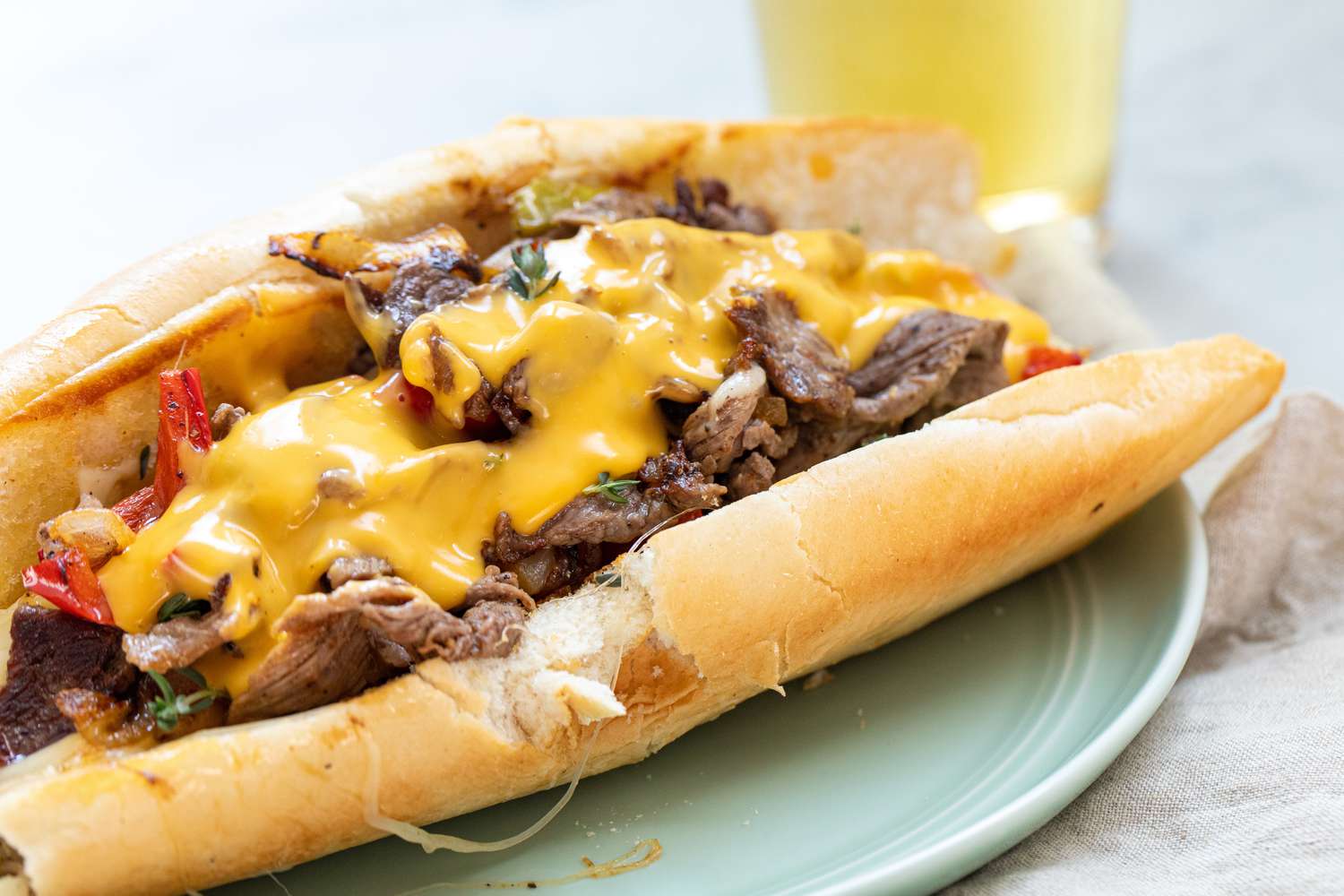
The Philly cheesesteak, iconic American comfort food high in saturated fat, emblematic of the guidelines' internal contradiction between promoting "real food" and limiting saturated fat
This tension is not merely academic. It plays out every day in family kitchens, school cafeterias and restaurant menus across the country. When official guidance simultaneously champions a food and warns against its primary nutrient, it leaves healthcare providers, educators and consumers without a reliable compass. The result is a document that, for all its ambition, risks deepening the very confusion it was designed to resolve. The need for greater precision and greater scientific courage has never been more urgent.
"When official guidance simultaneously champions a food and warns against its primary nutrient, it leaves everyone without a reliable compass."
The Visual Story: A Pyramid Rebuilt, But For Whom?
Every set of dietary guidelines needs a visual shorthand, a symbol to encapsulate its philosophy. We had the Food Pyramid, then MyPlate. The 2025-2030 edition introduced a new graphic, a symmetrical triangle meant to convey balance. But a picture is worth a thousand words, and the words this one whispers are telling. Critics quickly noted that the triangle could easily be misinterpreted as an inverted pyramid, with a heavy visual emphasis on its top tier. And what resides there? Images of steak, ground meat, whole milk, and cheese share space with fruits and vegetables. Legumes and nuts are present but visually diminished; soy foods, a major global source of plant protein, are absent entirely.
This isn't a minor design quirk. It's a powerful, subconscious message about dietary hierarchy. It visually shifts the recommended diet toward an animal-protein-predominant model, a move that aligns with certain cultural ideals but diverges from a growing body of science advocating for more plant-forward patterns for both human and planetary health. The graphic tells a story of a plate centered on meat and dairy, marginalizing the very plant-based proteins that are linked to lower risks of chronic disease and have a lighter environmental footprint. For individuals who cannot or choose not to consume dairy, the message is one of exclusion. The visual language, therefore, becomes a battleground. Is it illustrating 'real food' as defined by a particular vision of American agriculture, or is it illustrating the optimal diet for human health as defined by contemporary global science? The new graphic suggests these two visions are not yet the same.
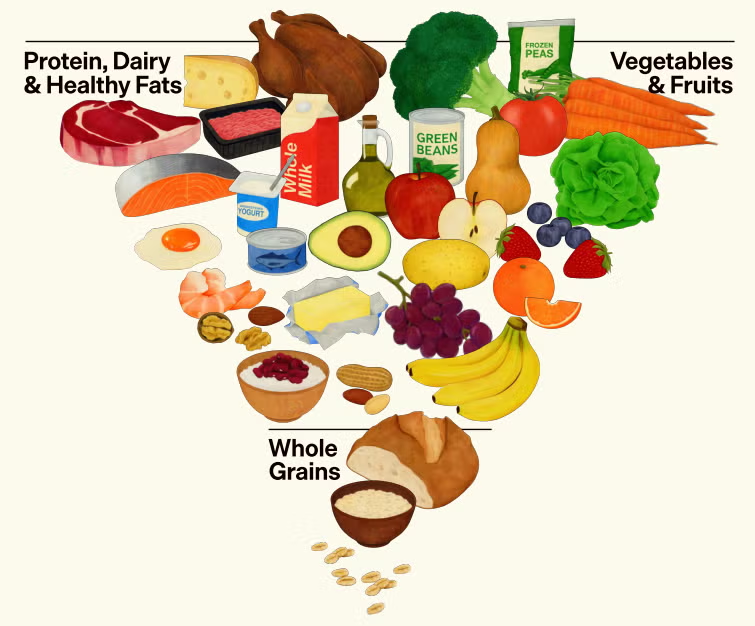
The new 2025-2030 dietary graphic: a symmetrical triangle whose visual hierarchy has drawn criticism from nutrition scientists worldwide
The Global Context: How the World is Reading the Label
While America debates its internal guidelines, a quiet revolution in consumer empowerment is unfolding on grocery shelves worldwide. The translation of complex dietary advice into instant, at-a-glance understanding has become the new frontier of public health. This is the world of front-of-pack (FOP) nutrition labels, and the global experiments provide a stark contrast to the ambiguities of the new U.S. guidelines.

Consumers navigating supermarket aisles, front-of-pack labelling systems worldwide aim to make healthy choices easier at the point of purchase
In Chile and Mexico, stark black octagon warning labels shout 'HIGH IN' sugar, sodium, or saturated fat. These are not gentle suggestions; they are unambiguous traffic stops for the shopping cart. Studies from Chile show this blunt approach works, leading to significant reductions in the purchase of sugary drinks and forcing manufacturers to reformulate products. In Europe, the color-coded Nutri-Score (A to E) gives a product a grade, while the UK's traffic light system uses red, amber, and green to signal nutrient levels. Australia's Health Star Rating condenses it all into a simple score. These systems are responses to the same crisis the U.S. guidelines address, but they operate on a different principle: radical transparency at the point of purchase.
This global shift highlights a critical gap in the U.S. approach. The 2025-2030 guidelines can advise limiting added sugars to less than 10 grams per meal, but how is a parent, rushing through a supermarket aisle, supposed to calculate that? The guidelines condemn ultra-processed foods, but without a tool like the NOVA classification system being popularized, how does one easily identify them? The rest of the world is moving toward giving consumers a flashlight to navigate the dark forest of food marketing. The new U.S. guidelines, for all their talk of a reset, largely leave Americans fumbling in that same dark, armed only with a complex map they must decipher at home. The lesson from abroad is that clear, mandatory, and interpretive labeling isn't paternalism; it's the necessary infrastructure for turning national policy into daily practice.
The Unseen Forces: Science, Politics, and the Plate
To understand the contradictions within the 2025-2030 guidelines, one must look beyond the nutrition science to the powerful currents that shape it. The development of federal dietary guidance has never been a purely academic exercise. It is, by its nature, a political document, a consensus forged in the fiery crucible of economic interests, cultural values, and bureaucratic process. The administration's press release framed the new guidelines as a liberation from decades of corporate influence, a restoration of truth. Yet, the resulting inconsistencies suggest that replacing one set of influences with another does not necessarily lead to clarity.
The emphasis on animal proteins and full-fat dairy, despite the saturated fat warning, echoes long-standing agricultural priorities and cultural narratives about strength and purity associated with these foods. The de-emphasis of plant-based proteins and soy overlooks not only their health benefits but also a massive shift in consumer demand and global sustainable diet frameworks, like the EAT-Lancet Commission. Furthermore, the guidelines' approach to non-nutritive sweeteners—calling for moderation despite evidence supporting their safety as a sugar-reduction tool—hints at a preference for 'natural' over 'artificial' that is more ideological than evidential.
This tension reveals the central challenge of modern dietary guidance: it must be a servant to two masters. The first is the relentless, evolving march of nutritional science, which increasingly points toward patterns rich in plants and low in processing. The second is the complex reality of a national food system, entrenched cultural habits, and political economy. The 2025-2030 guidelines represent a dramatic attempt to simplify the message —'eat real food'—but in doing so, they have papered over some of the most critical nuances that science has uncovered. The result is a document that feels both revolutionary and retrograde, a reset that has yet to fully align the compass with the most reliable stars of evidence.
Beyond the Guidelines: The Real-World Plate of Tomorrow
The true impact of any dietary guideline is not measured in its press coverage, but in the slow, collective shift of millions of daily choices. The 2025-2030 reset lands in a world where the food landscape is already transforming from the ground up. The 'plant-based revolution' is not a fringe trend but a mainstream market force, driven by health, environmental, and ethical concerns that the guidelines only faintly acknowledge. Consumers are seeking out legumes, nuts, and meat alternatives not because a government triangle tells them to, but because they are connecting their personal health to the health of the planet.
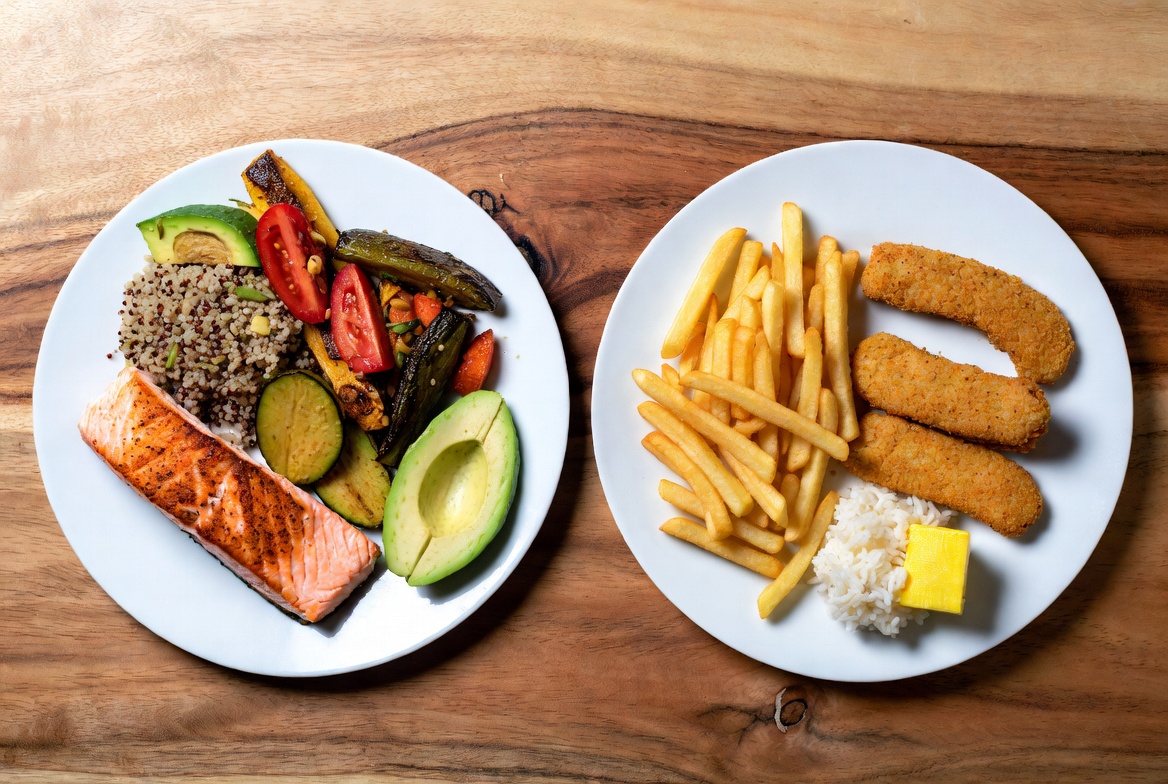
The contrast in modern food choices: a nutrient-rich plate (grilled salmon, quinoa, avocado, vegetables) versus a heavily processed meal, the decision millions face every day
Simultaneously, the conversation about food is expanding from 'what to eat' to 'how it's made.' The guideline's strong stance against ultra-processed foods validates a growing public skepticism toward ingredient lists that read like chemistry experiments. This is pushing innovation toward 'clean-label' products and is empowering a movement that values culinary skills and home cooking as acts of health sovereignty. The future suggested by these converging trends is one of greater awareness, but also greater personal responsibility. It points toward a diet that is not just about avoiding disease, but about seeking positive nourishment—foods that are as good for the gut microbiome as they are for the local farmer.
In this context, the new guidelines are less a definitive map and more a significant marker in an ongoing journey. They have successfully elevated the critique of food processing to official policy, a monumental step. Yet, by clinging to certain traditional protein sources without sufficient nuance, they have also created a roadmap with conflicting directions. The task for Americans now is to navigate with both documents in hand: the official guidelines that warn against processed foods and sugars, and the emerging, global consensus that points toward a more plant-centric, sustainable, and transparent food future. The real reset will happen not in Washington, but in kitchens, farms, and grocery stores, as people stitch together their own wisdom from the threads of science, culture, and the powerful, simple desire to feel well.
Conclusion
The release of the 2025-2030 Dietary Guidelines for Americans will be remembered not for providing final answers, but for vividly illuminating the profound tensions in our national relationship with food. It is a document born of crisis—the unsustainable cost of diet-related disease—and of a fierce desire to return to simplicity. In its bold condemnation of ultra-processed foods, it offers a crucial piece of clarity in a confusing nutritional landscape. But in its internal contradictions, particularly around protein and fat, it reflects a nation still divided between its culinary past and its epidemiological future. The guidelines are a mirror, and in it we see the reflection of our struggle: a search for wholesome nourishment caught between the powerful allure of tradition, the compelling weight of new science, and the relentless engine of the food industry. The path to healthier eating was never going to be a straight line drawn by a single committee. It is, and will remain, a winding road paved by individual choices, scientific discovery, and the enduring hope that the food on our plates can be a source of vitality, not just calories. The great American food reset has begun, but the final edit is still being written, one meal at a time.